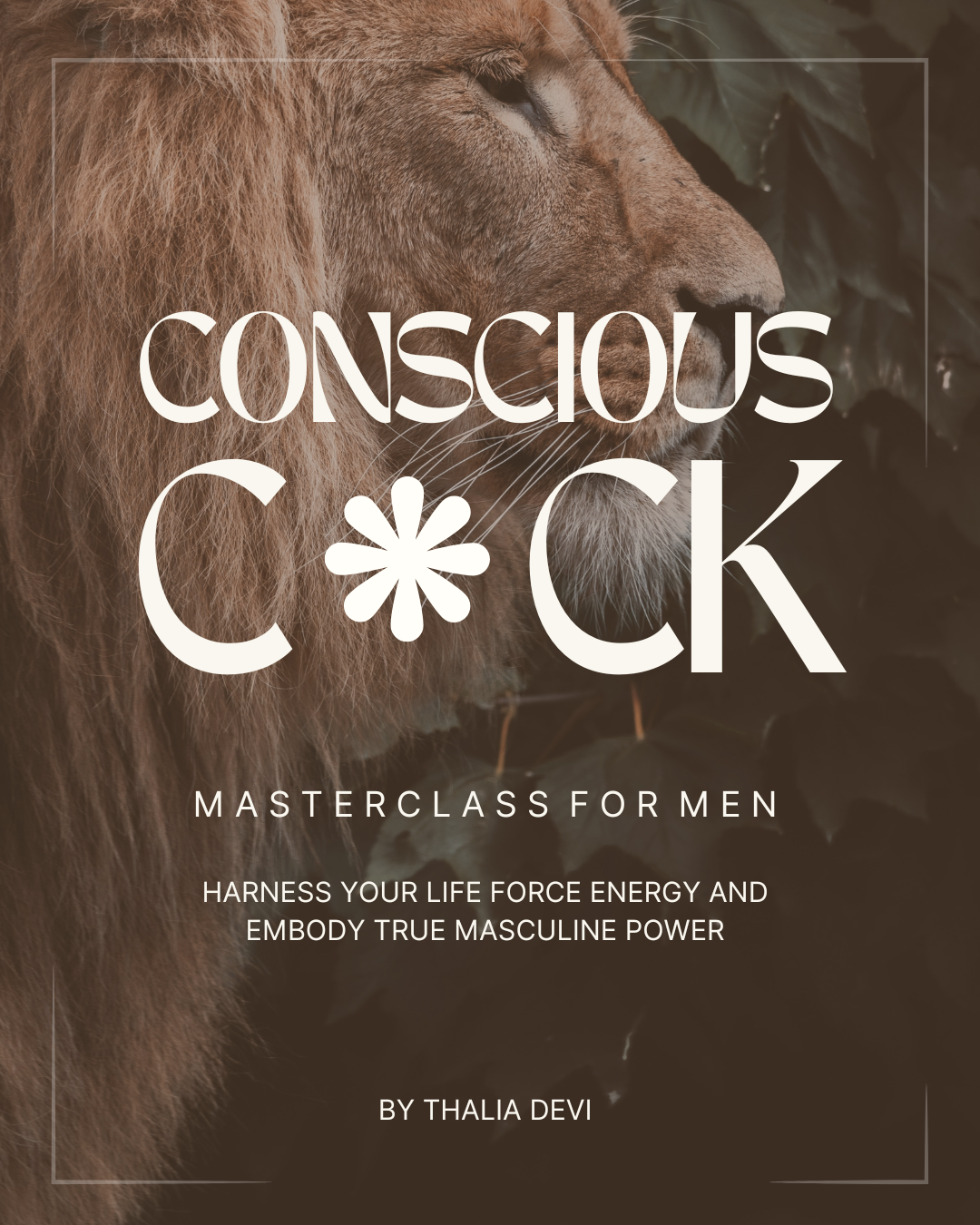
Dear Man,
If you’re like most men, you’ve never been taught how to work consciously with your sexuality.
Instead, you’ve been left to navigate shame, performance, pornography, confusion, and disconnection on your own.
What if your sexual energy wasn’t a problem to overcome, but one of your greatest sources of vitality, confidence, and masculine power?
In this 90-minute live masterclass, I’ll introduce you to the Tantric principles that can transform your relationship with your sexuality—from something unconscious into something deeply empowering.
90 min Masterclass
Price: CA $88
testimonial
“Now in my early 40s, I’ve been reflecting a lot on my sexuality and how I experience intimacy. I had been searching for thoughtful, grounded resources online but struggled to find anything that truly resonated.
Finding Thalia’s Conscious Cock Masterclass was exactly what I had been looking for. The content was insightful, practical, and directly addressed many of the questions I’d been asking myself over the past few years. It gave me greater clarity while also encouraging deeper self-reflection.
What stood out most was Thalia’s ability to communicate. She has a calm, compassionate, and non-judgmental way of explaining complex topics that immediately inspired confidence and made the material feel accessible.
After completing the masterclass, I felt confident enough to continue the journey and enrolled in her Lust to Love online course. I’m genuinely looking forward to diving deeper and would highly recommend the masterclass to anyone wanting to develop a healthier, more conscious relationship with their sexuality.”
Be honest…
Why do you really want sex?
Not the socially acceptable answer. The real one.
Most men have never been taught to ask themselves that question. We're told it's biological, instinctual, just what men do. But sexuality is rarely just physical. Sometimes you're seeking connection. Sometimes validation. Sometimes relief. Sometimes power. Sometimes you simply don't want to feel alone. Sometimes you're trying to prove you're enough. And sometimes, if you're really honest, you don't even know.
None of this makes you broken. It makes you human.
But unconscious sxuality will always lead your life somewhere. The question is whether you're leading it, or whether it's leading you.
We live in a culture where our desires have become fragmented from a deeper truth. When your sexuality becomes separated from your heart, when your desire becomes separated from your purpose, and when your body moves without your awareness, you begin searching outside yourself for something that has always lived within.
This isn't about becoming less sexual. It's about becoming more conscious, more present, and more powerful. Because the quality of your sexuality often reflects the quality of your relationship with yourself. And when that relationship changes, it changes far more than your sex life. It changes how you lead, how you love, and how you live.
That's the conversation we're having inside Conscious C 🍆K Masterclass.
From Performance to Presence
One of the greatest misconceptions many men carry is that their worth as a partner is measured by performance.
Questions like:
How long should I last?
Am I doing enough?
Will I satisfy my partner?
What if my body doesn't respond the way I want it to?
These questions create enormous pressure. Ironically, that pressure often pulls a man away from the very thing that creates meaningful intimacy: presence.
Modern culture frequently promotes unrealistic expectations about what intimacy is supposed to look like. It's easy to compare ourselves to images, stories, or ideals that don't reflect the complexity and individuality of real human connection.
A different perspective begins by asking a different question.
Rather than measuring success by performance, what if we measured it by presence?
Presence is the capacity to stay connected—to yourself, to your breath, to your body, and to the person in front of you. It allows curiosity to replace self-judgment and connection to replace comparison.
Our bodies are dynamic. They change from moment to moment, influenced by stress, emotions, energy, health, and the quality of connection we feel. Learning to relate to those changes with awareness instead of criticism can transform the experience of intimacy.
When we stop treating the body as something to control and begin relating to it as something to understand, a different kind of confidence emerges. It is no longer built on proving ourselves, but on trusting ourselves.
This shift—from performance to presence—is not only valuable in intimate relationships. It has the potential to influence how we communicate, how we lead, how we respond under pressure, and how we move through the world.
Presence is not the absence of imperfection.
It is the willingness to remain connected, even when we are imperfect.
And that may be one of the most powerful forms of confidence a person can cultivate.
*Final Sale: Due to the digital nature of this masterclass, all purchases are final and non-refundable.
“I loved the masterclass and will definitely be watching it again. Right away, I could tell you’re an exceptional communicator. Not only is your content rich and deeply informed, but you deliver it with intelligence, humor, and sensitivity. Your pacing is impeccable, you speak with confidence and clarity, giving people the space to truly absorb what you’re teaching.”
Testimonials
“Several times throughout the masterclass, I paused the video simply to reflect. I found myself questioning what language I use for my body, where my beliefs about sexuality come from, and whether I’m more focused on how I appear or on how I truly connect with another person.”
“My favorite part was the guided exercise at the end, connecting with my heart and my cock to discover what they truly wanted. For me, this kind of embodied practice is even more valuable than theory. It helped me see myself in a completely new way.”